The Complete Guide to Bathroom Renovation Costs in New Zealand (2026)
Introduction: Understanding Bathroom Renovation Costs in New Zealand
Planning a bathroom renovation in New Zealand requires a clear understanding of the potential costs and what you get for your budget. In recent years, many Kiwis have opted to renovate rather than relocate, reinvesting in their homes amid a cooling housing market. This guide breaks down bathroom renovation costs into three tiers, Budget, Mid-Range, and High-End, with typical scopes, price ranges (in NZD), regional variations across Auckland, Wellington, Christchurch, and Southland, key cost drivers, partial upgrade pricing, and value-for-money upgrade tips.
These figures will help you plan your project and decide where to spend, whether the budget is tight or generous.
Budget Bathroom Renovation: $16,500 - $27,500
What’s Included in a Budget Renovation
A budget-level professional renovation provides all the essentials with minimal frills. It typically involves updating the basic fixtures without changing the layout or moving plumbing, which is one of the biggest cost-saving strategies. Here’s what you can expect:
Fixtures: A standard toilet ($440-$660), a single basin vanity ($880-$1,650), and a simple bathtub with a shower-over-bath configuration. This shower-head-above-tub setup maximises functionality in a small space without the cost of separate shower enclosures.
Surfaces: Waterproofed tile flooring (often ceramic tiles) and a mix of tiled wet-area walls around the bath and shower, plus painted walls elsewhere. Tiling is kept to a minimum (half-height wall tiling or splash zones) to save cost, with other areas in durable bathroom paint.
Fittings & Finish: Basic but reliable tapware, a single inexpensive mirror or mirror-cabinet, and standard lighting and ventilation. Accessories like towel rails are functional and affordable. The overall style is simple and neutral, easy to dress up with your own towels and decor.
Budget renovations work best when you retain the existing layout, avoiding expensive plumbing rework, and use off-the-shelf products rather than custom-made items. A typical budget bathroom includes everything you need with minimal fuss for roughly $20,900-$27,500 total.
Regional Cost Variations for Budget Renovations
Location significantly influences even budget renovation costs. In Auckland, expect the upper end of budget ranges, where a basic renovation might be closer to $22,000+ due to higher trade rates. In contrast, smaller regions like Southland or Christchurch might complete a similar basic bathroom for 10-20% less, assuming trades are available, because labour rates and demand pressure are lower.
For instance, outside Auckland a simple like-for-like bathroom refresh could be under $16,500, whereas in Auckland it may reach $19,800 or more.
Mid-Range Bathroom Renovation: $22,000 - $38,500
Quality Upgrades and Enhanced Features
A mid-range renovation delivers a significant step-up in both aesthetics and quality. These projects often involve a complete overhaul of the bathroom with moderate upgrades in materials and fixtures:
Layout: Generally keeps the fundamental layout to contain costs, but may allow minor tweaks. For example, you might replace a bath with a larger shower or add a new niche, as long as plumbing points remain mostly in place.
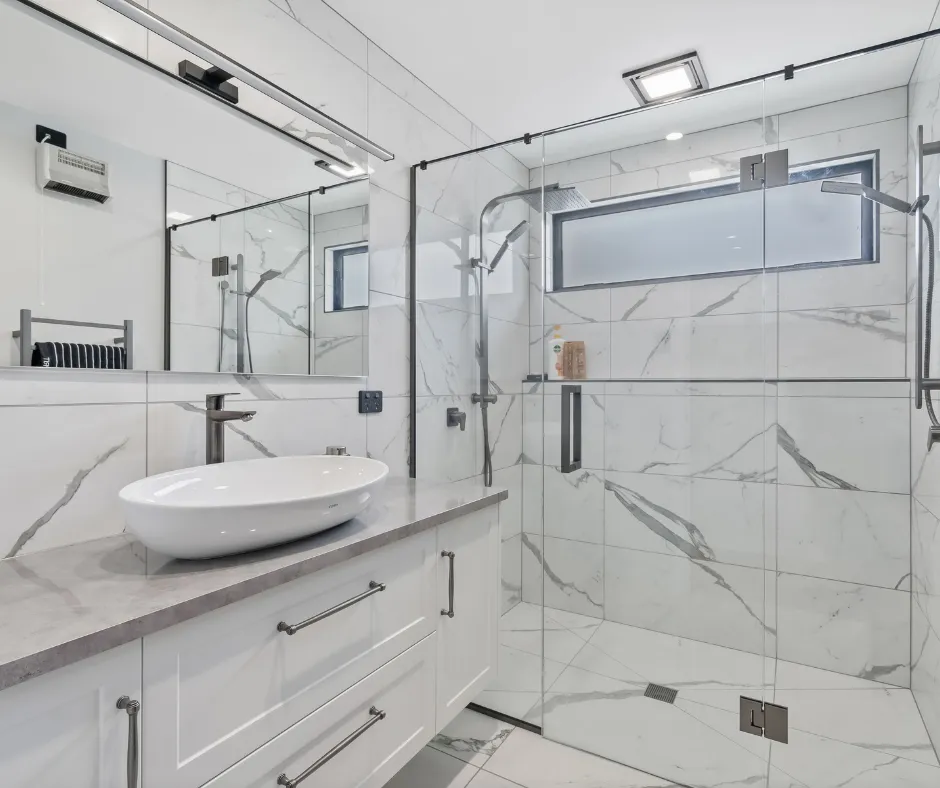
Fixtures & Amenities: A mix of upgraded fixtures including a back-to-wall freestanding bathtub for a designer look, a separate fully enclosed shower cubicle with glass door, a sleek wall-hung vanity, and a quality toilet suite. You might see nicer features like a frameless glass shower screen or a rainhead shower fixture for a touch of luxury.
Finishes: Better flooring and wall finishes with wood-look or textured tiles on the floor, tiled walls to a higher extent with decorative accents, and premium paint or feature walls. The style is bright and fresh with more design flair and personalisation than basic bathrooms.
Fittings & Lighting: Mid-tier tapware in trendy finishes (black or stainless steel), a larger mirror or mirrored cabinet, and improved LED downlights or vanity lighting. Heated towel rails or underfloor heating mats might be included as affordable luxuries at this level.
Mid-range bathrooms typically cost $22,000-$38,500 for a standard-size bathroom. This budget covers a full strip-out and replacement of all fixtures and finishes using good-quality materials. Homeowners can personalise these bathrooms with nicer finishes while staying within a moderate budget.
Regional Price Differences
The price gap between regions becomes pronounced in this tier. Auckland mid-range bathrooms cost roughly 20-30% more than similar projects in lower-cost regions. An Auckland homeowner might pay about $27,500-$35,200 for a mid-level renovation that might only cost $19,800-$27,500 in Christchurch or Hamilton.
High labour rates and demand in Auckland push up the total. Wellington is also on the higher side, not far behind Auckland, whereas a mid-range renovation in Southland or Marlborough could see savings in labour (though materials costs remain similar nationwide).
High-End Luxury Bathroom Renovation: $38,500 - $66,000+
Premium Features and Custom Design
High-end renovations deliver a premium, custom result, often comparable to a luxury spa or upmarket hotel bathroom. These projects involve top-quality materials, custom design elements, and sometimes layout changes or expansion:
Layout Changes: High-end renovations aren’t constrained by the existing layout. They may involve moving plumbing fixtures, knocking through to adjacent space to enlarge the bathroom, or creating a fully tiled wet-room style shower. Structural modifications and council consents can come into play here.
Premium Fixtures: Virtually every fixture is upgraded. Expect a freestanding designer bathtub (stone or cast iron, possibly jetted spa bath), a large walk-in shower with frameless glass and dual showerheads (rainfall shower, body jets), and double vanities or custom vanity cabinetry. High-end toilets might include wall-hung models or smart bidet functions.
Luxury Finishes: Floor-to-ceiling porcelain or natural stone tiles, high-grade glass, custom lighting design, and high-end hardware. Heated flooring, demisting smart mirrors, and integrated lighting features are often included. Every detail, down to towel hooks and trim, is upgraded in quality.
High-end bathroom renovations generally start around $38,500 and can range upward to $55,000-$66,000+ depending on the extent of luxury and customisation. If significant construction is involved, costs can escalate to $77,000-$99,000 range, though those are outliers.
Luxury Pricing Across Regions
At the luxury level, Auckland tends to incur the highest costs. High-end projects in Auckland often run $44,000-$71,500 or more, whereas a similar top-spec bathroom in a smaller market might be $33,000-$55,000 in total. Outside major centres, slightly lower labour costs and less regulatory overhead can temper the budget.
However, even in cheaper regions, true luxury features (imported stone, custom glass) will still be expensive. In short, luxury comes at a cost everywhere, with Auckland and Wellington still topping the price scale due to higher hourly rates, council fees, and demand.
Regional Cost Variations Across New Zealand
Auckland: The Premium Market
Auckland is the most expensive region for renovations. High demand for tradespeople and a higher cost of living translate to higher labour charges. Plumbers, electricians, and tilers in Auckland often charge $88-$132+ per hour, compared to $66-$99/hour in smaller towns.
This “Auckland premium” can add roughly 20-30% to the total cost of a bathroom project compared to the national average. Even minor jobs cost more: a simple cosmetic update that might be $3,300 in rural NZ could run $4,400-$5,500 in Auckland. Additionally, Auckland Council building consent fees (often $550-$2,200) and logistics add to the cost.
Wellington: Capital City Pricing
Wellington’s renovation costs are also relatively high. Being a metro area, Wellington’s labour rates are closer to Auckland’s than to rural rates. Homeowners in Wellington can expect bathroom quotes somewhat lower than Auckland’s, but still above the national median, perhaps around 10% less than an Auckland job of similar scope.
The hilly terrain and older housing stock in Wellington can add complexity, potentially influencing labour effort and cost.
Christchurch and Canterbury: More Affordable
Christchurch generally enjoys 10-20% lower renovation costs than Auckland/Wellington for comparable work. Post-earthquake rebuilding led to a competitive construction industry and improved supply chains. Labour rates are more in line with the national average.
For instance, an extensive bathroom renovation quoted at $55,000 in Auckland might be in the low-$40s in Christchurch. The availability of materials locally is good, often meaning less freight cost than for remote regions.
Smaller Regions: Best Value
In provincial areas like Southland, West Coast, and Marlborough, labour is often cheaper with contractors charging closer to $55-$88/hour. Building cost data shows these as the three most affordable places to build, suggesting renovation costs track lower as well.
A Southland bathroom renovation might come in below the national average. However, in very small towns with limited local tradespeople, you might have to bring in specialists from larger cities, and travel costs can eat into those savings.
Key Cost Drivers and Influences
Labour Costs: The Biggest Expense
Labour is often the single largest cost component, typically accounting for 40-50% of the total renovation budget. Bathrooms are labour-intensive because they require multiple licensed trades: builders, plumbers, electricians, tilers, painters, and waterproofing specialists.
Even a mid-range bathroom can easily incur $11,000-$16,500 in combined labour fees in a city like Auckland. What drives labour cost up? Complex work like relocating plumbing, extensive custom tiling, or fixing structural issues will add many hours.
Managing labour costs is crucial. Hiring experienced professionals can actually save money by doing it right the first time. Avoid unnecessary changes that require additional trades. Moving a toilet, for instance, involves not just the plumber but also the builder and possibly council inspections.
Quality of Materials and Fixtures
The materials and products you choose have a major impact on price. There’s a huge range in New Zealand:
- Tiles: $22 per m² for basic ceramic to over $165 per m² for high-end stone or designer tiles
- Bathtubs: $440 for simple acrylic to $11,000+ for luxury freestanding stone baths
- Vanity basins: $110 for basic models up to $1,100+ for premium designs
- Toilets: $330-$660 for standard suites
Using premium fittings can easily double or triple the material budget compared to standard options. Often, mid-range products offer an excellent balance of durability and price. For example, a good quality porcelain tile might serve just as well as a much pricier marble slab, with far less maintenance.
Bathroom Size and Layout Complexity
Larger bathrooms require more of everything: more tiles, more paint, more labour hours. A 5m² bathroom might use around 20m² of tiles (walls and floor), whereas a 15m² bathroom could need 3× that area tiled at approximately $198-$275 per m² installed.
However, layout complexity can matter more than pure size. Changes to layout (relocating the toilet, converting a closed shower to an open wet-room) tend to increase costs significantly because they involve additional plumbing, drainage work, and often council consent.
Keeping plumbing fixtures in their existing positions is one of the biggest cost savers. Every time you move a toilet, shower, or sink, you incur new pipework and potentially electrical re-wiring, which can add $2,200-$5,500+ to your project.
Waterproofing and Wet Area Requirements
Comprehensive waterproofing is critical and non-negotiable. If you plan a full wet-room (entire bathroom floor as a showering zone), you’ll need comprehensive waterproofing and flush drainage systems, requiring certified waterproofers and experienced tilers.
A custom tiled shower installation in NZ can range roughly $1,650 to $8,800 depending on size and specifications. By contrast, a one-piece acrylic shower insert might be only a few hundred dollars plus installation.
Waterproofing typically accounts for approximately 5-10% of the total budget, but it’s money well spent. Water damage from poor waterproofing will far outweigh any upfront savings.
Permits and Building Consent
Generally, like-for-like replacements (new fixtures in the same positions) do not require building consent. However, certain changes do trigger consents:
- Relocating plumbing fixtures may require a minor plumbing consent
- Altering structural walls or adding windows needs consent
- Creating a new wet room where one didn’t exist might need approval
Consents typically cost a few hundred to a couple thousand dollars in fees and documentation. They also add time for council processing and may require drawings from a designer or plumber.
Costs for Partial Bathroom Upgrades
Vanity Replacement: $550 - $2,200+
Replacing just the vanity is a popular refresh. A basic single-sink vanity unit (600-900mm wide) costs $330-$880, while higher-end vanities run $1,650-$3,300 or more. Add plumber installation at $90-$132/hour for a few hours, typically $330 for a straightforward swap.
Upgrading from a single to a double vanity increases plumbing costs (two basins to connect), running $2,750-$4,400 including a quality double vanity unit.
Shower Upgrades: $1,650 - $8,800
Like-for-like shower replacement: A basic shower kit (acrylic base + glass door) costs $550-$1,650. Add installation and disposal of the old unit, and this swap could be roughly $1,650-$3,300 total.
Custom tiled shower: A fully tiled, walk-in shower typically ranges $4,400-$8,800 depending on size and hardware. This includes waterproofing, tiles, custom glass screen, and installation labour.
Shower-over-bath addition: Adding a showerhead above an existing bathtub is very cost-effective. A plumber can fit a shower mixer/tap for a few hundred dollars (plus the cost of tapware). With a shower curtain or glass bath screen ($220-$880), you can achieve this for under $1,650.
Tiling and Flooring: $880 - $1,375 for Small Bathrooms
Floor tiling: All-inclusive (tile + install + waterproof underlay), expect about $198-$275 per square metre. For a typical 5m² bathroom floor, that’s roughly $990-$1,375.
Wall tiling: Similar rates per m² ($198-$275/m²). Tiling a 3m² shower enclosure might cost around $2,200.
Vinyl flooring alternative: Modern bathroom-grade vinyl costs around $88-$110 per m² installed, often half the cost of tiles. For a small bathroom, you might re-floor in vinyl for under $1,100.
Single Fixture Replacement: $550 - $1,100
Swapping an old toilet for a new one: $550-$1,100 total (toilet suite $330-$660 plus plumber’s time). Replacing a bathtub in an alcove: $880-$1,650. New tapware or showerhead: $165-$440 for fixtures, plus installation.
Best Value-for-Money Bathroom Upgrades
Heated Towel Rail: $385 - $880
One of the best value upgrades. Basic models cost $165-$330 (for a 4-5 bar rail in chrome), premium ones $550+. Electrician installation is usually $220-$330 for safe, hard-wired installation. They’re cheap to run (about 1 cent per hour) and instantly give the bathroom a more upscale, spa-like feel.
LED Lighting Upgrade: $550
Modern LED downlights cost $55-$110 each, and an electrician can retrofit them quickly. For around $550, a small bathroom could have a complete lighting revamp, giving a fresh look and lower running costs.
Shower-Over-Bath Installation: Under $1,650
If you only have a bathtub, adding a showerhead above it is extremely cost-effective. A plumber can install the necessary mixer/tap in a few hours, and with a curtain or glass screen, you can have both for under $1,650.
Modern Tapware and Showerheads: $220 - $440
Replacing dated taps and showerheads hugely improves user experience. Good mid-range taps from reputable brands cost $220-$440 each, with 1-2 hours for a plumber to install. The visual impact of shiny new faucets and better water flow is very rewarding.
Fresh Paint: $110
Never underestimate a fresh coat of moisture-resistant paint. For about $110 in paint, you can brighten and clean up a tired space. Painting is typically DIY-friendly if you’re on a tight budget.
Value-for-money upgrades focus on things people touch and see most (fixtures, lighting, heating) rather than structural changes. They tend to be lower cost and often don’t require council approval or multiple trades.
How Costs Have Moved, and Where They Sit Now
2023: Signs of Stabilisation
By 2023, some pressures began to ease after the extreme 2021-2022 inflation. Global shipping costs came down, and material supply improved. Construction cost growth slowed to around 2.7% annually by mid-2023, compared to the extreme jumps earlier.
Material prices started to plateau and supply of products became easier, with no more 6-month waits for materials. However, labour constraints remained, with skilled trades still booking out well in advance.
2024: High Costs, but Plateauing
Through 2024 and 2025 construction costs sat near their peak, but growth had flattened. By late 2024, the average cost increase was only around 1.5% year-on-year, against a 17% jump the previous year.
This suggests prices have adjusted to the new normal, and we’re not seeing further rapid increases. Key materials for bathrooms have stabilised in price. However, labour rates stayed elevated, especially in Auckland.
2026: Where Costs Sit Now
Costs have settled. We are not going back to pre-pandemic pricing, but increases are running at around the general inflation rate (2-5% per year).
Materials: Relatively stable, barring new global disruption. Some costs may ease if demand softens.
Labour: Still the wildcard. Skills shortages persist, though increased immigration of construction trades has taken some of the pressure off.
Budgeting: The tier figures in this guide reflect current pricing. If your project runs into next year, leave room for the usual annual drift.
Always include a 10-15% contingency in your budget for unexpected issues. Even if base costs stabilise, discovering plumbing leaks or rot during the renovation can add unforeseen expenses.
Conclusion: Planning Your Bathroom Renovation
Understanding bathroom renovation costs in New Zealand’s current market is essential for successful project planning. With a budget of $16,500 or $66,000+, the key is the same:
- Get multiple quotes from local professionals
- Keep plumbing fixtures in existing positions when possible to save $2,200-$5,500+
- Choose mid-range materials that offer durability without luxury markups
- Include a 10-15% contingency for surprises
- Focus value upgrades on high-touch items like fixtures, lighting, and heating
- Account for regional cost differences (Auckland 20-30% higher than smaller centres)
With careful planning and smart choices, you can achieve a beautiful, functional bathroom that adds value and comfort to your home, regardless of your budget tier. The renovation market has stabilised after the difficult 2021-2023 period, making now a good time to plan your project with more predictable pricing.
Ready to Start Your Renovation?
Let's discuss your project and create a stunning design that brings your vision to life.